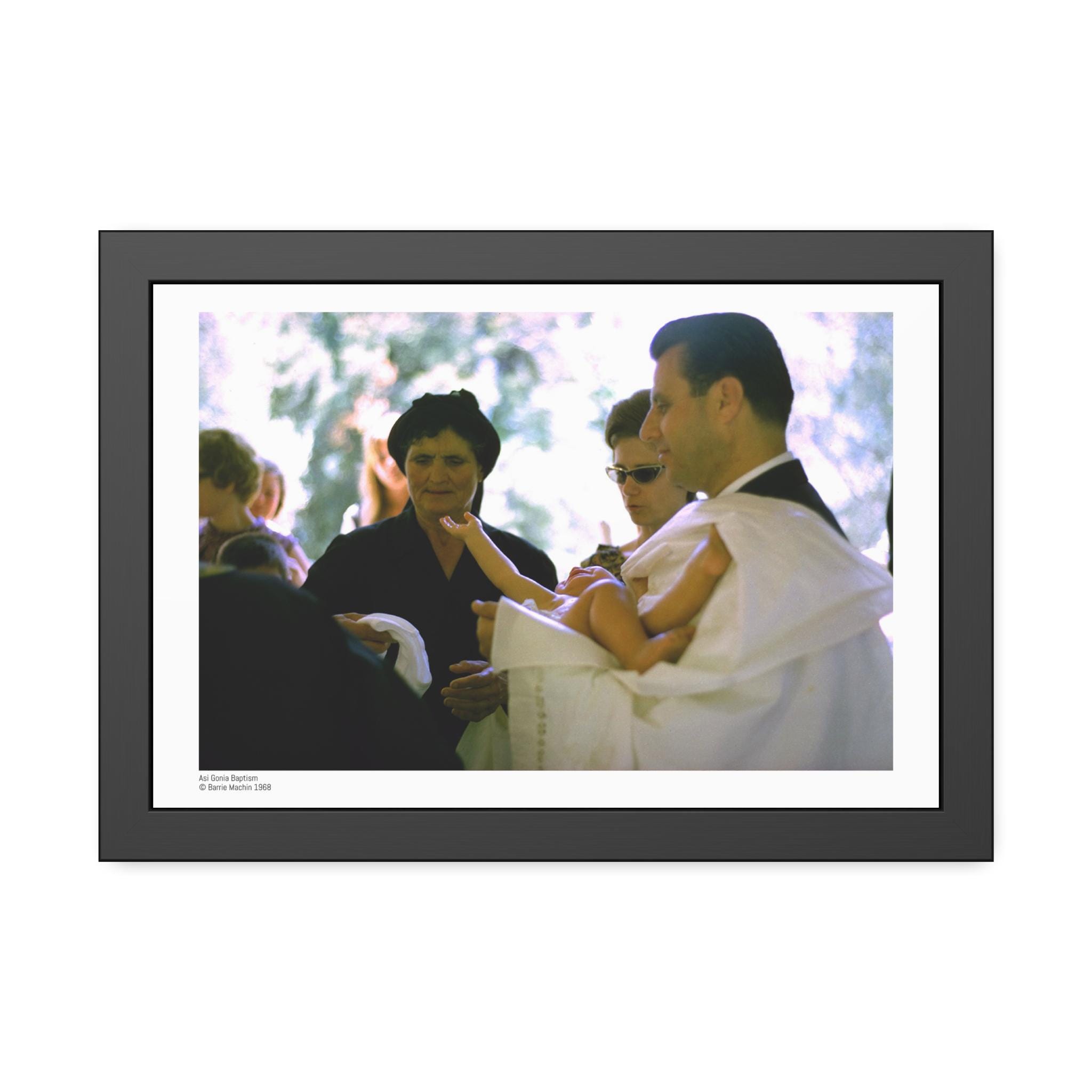
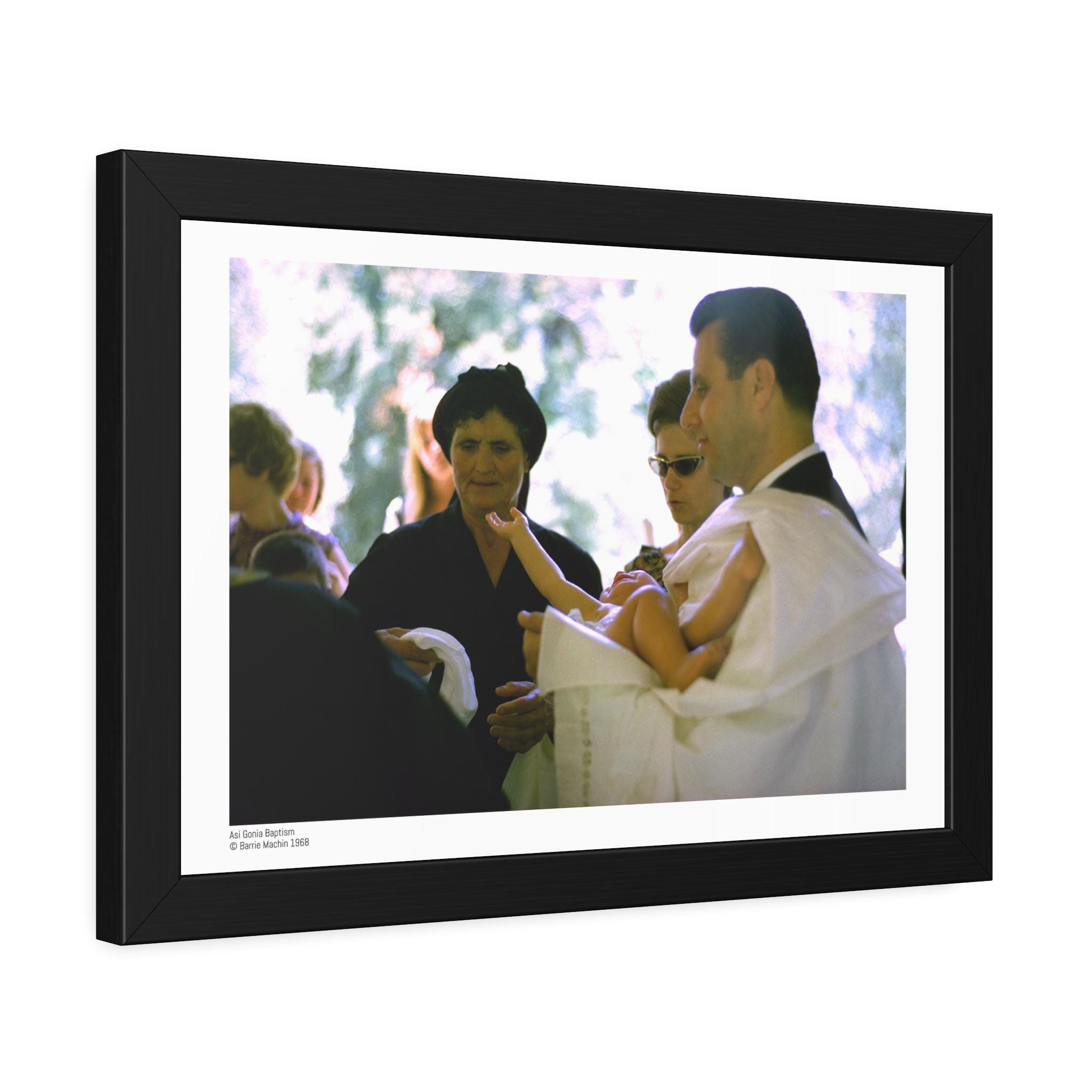

Asi Gonia Exhibition Baptism
AU$ 95.88

Arriors And Maidens: Baptism
Children are usually baptized by the time they are six months old. Before baptism they are thought to be particularly vulnerable to illness and malevolent influence. An unbaptized child will not go to heaven for baptism is the essential ceremony for the elimination of original sin and entry into the community of Christian souls. In Asi Gonia it takes place in the yard of the church because traditionally, unbaptized people could not enter the church. In ancient times baptism used to precede Easter as an essential prerequisite for adult entry into the physical structure of the Church. The procession was continuous with that of the Passion (Pascha) so that the rebirth of Christ coincided with symbolic rebirth of the person. Baptism inside the church is a recent innovation. During the baptism the Eucharistic prayer blessing the water recapitulates the miracle of creation and the salvation of the world through the birth and death of Christ. The ritual begins with exorcism to remove the devil. The priest takes the child from the midwife and breathes three times on its mouth, forehead and breast, signifying that the air has become purified from the devil and he may receive the breath of life (confirming the conformity of the Liturgy with local beliefs)— The three exorcisms (αφορκισμοί) are ultimate purifications from the influence of the Devil, who is involved in original sin. The Devil is addressed in person, as a concrete, tangible entity and is ordered to leave the body and soul of the infant. The priest then turns the candidate to face the west “unclad, unshod and having his hands uplifted.” Ιn infant baptism it is the godparent who faces the west, holding the child in his arms. He has to renounce “Satan, and all his Angels, and all his works, and all his service and all his pride,” three times in the present and three in the past tense. At the end he has to “blow and spit on Satan,” by which act the child’s separation from its previous “sinful” condition has occurred. Incorporation into Christianity and allegiance to Christ follows. The priest turns godparent and child towards the east, the world of light and regeneration (as opposed to the west, which is death and darkness), “with his hands lowered” (Chryssanthopoulou 1984 p.83 see appendix). The nonos (godfather) takes the child after the exorcisms and spits over its body to help drive away the Devil; the Priest then blesses the water: That this water may prove effectual unto averting of every snare of enemies both visible and invisible. That he who is baptized therein may be made worthy of the Kingdom incorruptible. Sanctify this water by the indwelling of Thy Holy Spirit. And grant unto it the grace of redemption, the blessing of Jordan. Make it the fountain of incorruption, the gift of sanctification, the remission of sins, the remedy of infirmation, the final destruction of demons...The water is then exorcised and consecrated. After this initial blessing of the water, the priest says: Wash away the vileness of my body, and the pollution of my soul. And sanctify me wholly by Thine All-Perfect, Invisible Might, and by Thy Spiritual Right Hand.After this, the service fashions the social anatomy of the child. The priest takes some oil with two fingers, and makes the sign of the cross upon his brow, his breast, and between his shoulders, saying, Thy Servant of God is anointed with the oil of gladness in the Name of the Father, and of the Son, and of the Holy Spirit. Amen. And he anoints the baby saying, unto the healing of soul and body, on the ears, Unto the hearing of faith, on the hands, Thy hands have made me and fashioned me, on the feet, That he may walk in the way of The Commandments. The priest immerses the child three times and blesses it in the name of the Trinity. Thus resurrected, the naked child is clothed in white and anointed with oil. After another immersion, the priest cuts off a lock of its hair. At the end he leads the congregation around the font saying that the child is created in the image of Christ. The service rejects natural sinful birth for a new social existence in the life of Christ.A framed paper poster that brings photographs and art prints to life with museum-quality paper and a sleek matte-black pinewood frame. Choose between textured fine art paper for a traditional watercolor or etching feel (310 gsm) or a bright semi-gloss photo paper (260 gsm). Each print is mounted behind shatter-proof plexiglass with a brown paper backing, arrives assembled with pre-installed top hanging hardware and rubber bumpers to protect walls and keep the frame perfectly level. Available in ten sizes and both horizontal and vertical layouts, these framed posters are printed with vibrant, crisp color reproduction using the latest printing techniques and assembled in the USA from globally sourced parts.Product features - Two paper choices: fine art (310 gsm) or semi-gloss (260 gsm) - Matte black 100% pinewood frame with brown paper backing - Shatter-proof plexiglass cover for safe display - Pre-installed top hanging hardware and rubber bumpers - Available in 10 sizes; horizontal and vertical optionsCare instructions - Clean framed prints with a slightly wet cloth when necessary.
Children are usually baptized by the time they are six months old. Before baptism they are thought to be particularly vulnerable to illness and malevolent influence. An unbaptized child will not go to heaven for baptism is the essential ceremony for the elimination of original sin and entry into the community of Christian souls. In Asi Gonia it takes place in the yard of the church because traditionally, unbaptized people could not enter the church. In ancient times baptism used to precede Easter as an essential prerequisite for adult entry into the physical structure of the Church. The procession was continuous with that of the Passion (Pascha) so that the rebirth of Christ coincided with symbolic rebirth of the person. Baptism inside the church is a recent innovation. During the baptism the Eucharistic prayer blessing the water recapitulates the miracle of creation and the salvation of the world through the birth and death of Christ. The ritual begins with exorcism to remove the devil. The priest takes the child from the midwife and breathes three times on its mouth, forehead and breast, signifying that the air has become purified from the devil and he may receive the breath of life (confirming the conformity of the Liturgy with local beliefs)— The three exorcisms (αφορκισμοί) are ultimate purifications from the influence of the Devil, who is involved in original sin. The Devil is addressed in person, as a concrete, tangible entity and is ordered to leave the body and soul of the infant. The priest then turns the candidate to face the west “unclad, unshod and having his hands uplifted.” Ιn infant baptism it is the godparent who faces the west, holding the child in his arms. He has to renounce “Satan, and all his Angels, and all his works, and all his service and all his pride,” three times in the present and three in the past tense. At the end he has to “blow and spit on Satan,” by which act the child’s separation from its previous “sinful” condition has occurred. Incorporation into Christianity and allegiance to Christ follows. The priest turns godparent and child towards the east, the world of light and regeneration (as opposed to the west, which is death and darkness), “with his hands lowered” (Chryssanthopoulou 1984 p.83 see appendix). The nonos (godfather) takes the child after the exorcisms and spits over its body to help drive away the Devil; the Priest then blesses the water: That this water may prove effectual unto averting of every snare of enemies both visible and invisible. That he who is baptized therein may be made worthy of the Kingdom incorruptible. Sanctify this water by the indwelling of Thy Holy Spirit. And grant unto it the grace of redemption, the blessing of Jordan. Make it the fountain of incorruption, the gift of sanctification, the remission of sins, the remedy of infirmation, the final destruction of demons...The water is then exorcised and consecrated. After this initial blessing of the water, the priest says: Wash away the vileness of my body, and the pollution of my soul. And sanctify me wholly by Thine All-Perfect, Invisible Might, and by Thy Spiritual Right Hand.After this, the service fashions the social anatomy of the child. The priest takes some oil with two fingers, and makes the sign of the cross upon his brow, his breast, and between his shoulders, saying, Thy Servant of God is anointed with the oil of gladness in the Name of the Father, and of the Son, and of the Holy Spirit. Amen. And he anoints the baby saying, unto the healing of soul and body, on the ears, Unto the hearing of faith, on the hands, Thy hands have made me and fashioned me, on the feet, That he may walk in the way of The Commandments. The priest immerses the child three times and blesses it in the name of the Trinity. Thus resurrected, the naked child is clothed in white and anointed with oil. After another immersion, the priest cuts off a lock of its hair. At the end he leads the congregation around the font saying that the child is created in the image of Christ. The service rejects natural sinful birth for a new social existence in the life of Christ.A framed paper poster that brings photographs and art prints to life with museum-quality paper and a sleek matte-black pinewood frame. Choose between textured fine art paper for a traditional watercolor or etching feel (310 gsm) or a bright semi-gloss photo paper (260 gsm). Each print is mounted behind shatter-proof plexiglass with a brown paper backing, arrives assembled with pre-installed top hanging hardware and rubber bumpers to protect walls and keep the frame perfectly level. Available in ten sizes and both horizontal and vertical layouts, these framed posters are printed with vibrant, crisp color reproduction using the latest printing techniques and assembled in the USA from globally sourced parts.Product features - Two paper choices: fine art (310 gsm) or semi-gloss (260 gsm) - Matte black 100% pinewood frame with brown paper backing - Shatter-proof plexiglass cover for safe display - Pre-installed top hanging hardware and rubber bumpers - Available in 10 sizes; horizontal and vertical optionsCare instructions - Clean framed prints with a slightly wet cloth when necessary.